
Plumbing
Why Plumbers Wait 42 Days for Payment (And How to Cut It Down)
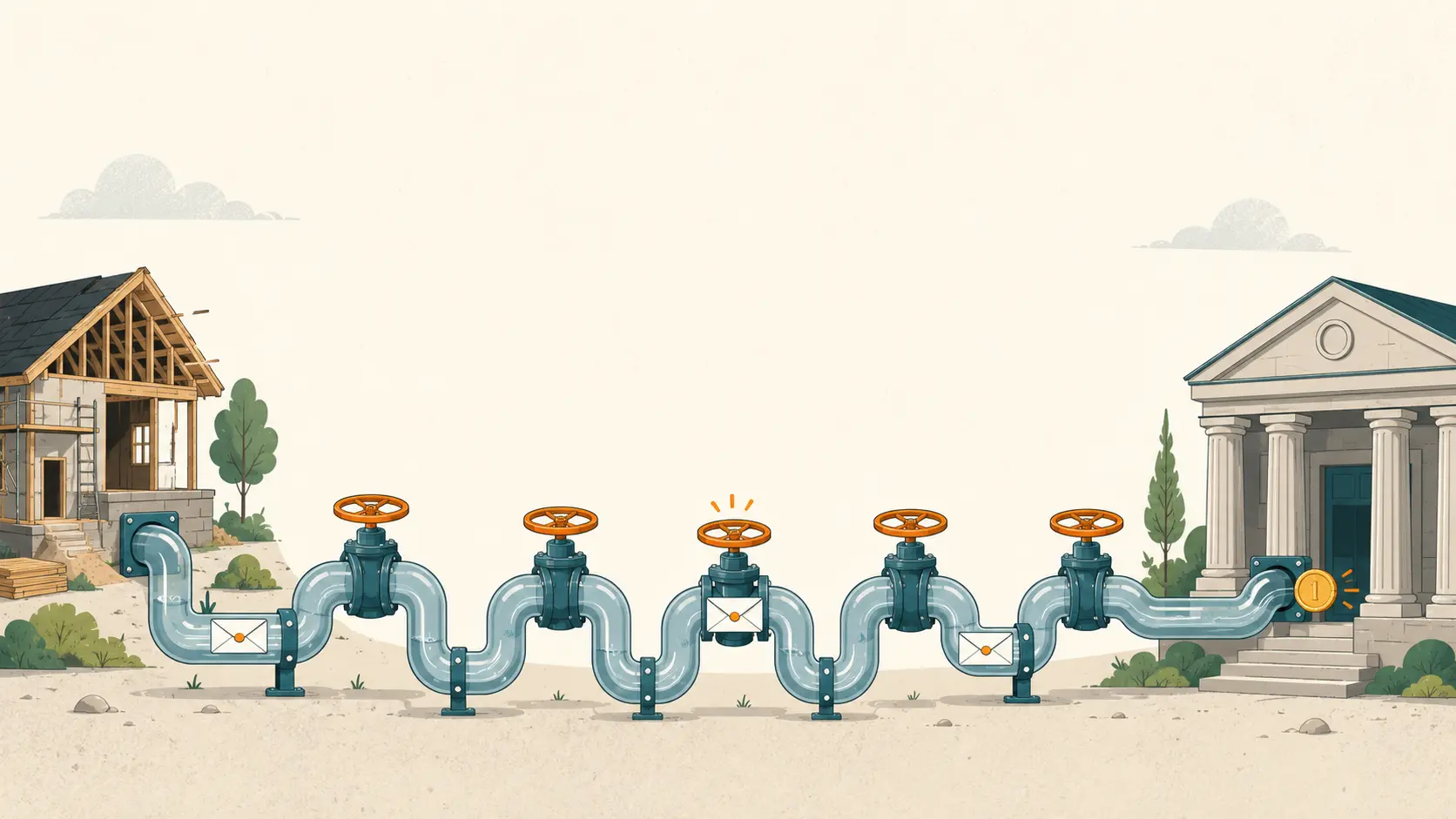
Forty-two days. That's the average wait between completing a plumbing job and seeing the money hit your account. Payroll lands every Friday. The GC's check lands sometime in mid-July. Subcontractor payment delays don't show up cleanly in a P&L; they show up when you're writing a personal check to keep your techs paid because the GC's draw got pushed by two weeks.
Net 60 has quietly become the residential and commercial construction reality, even on contracts that say net 30. Nobody publishes a clean payment-cycle number for residential plumbing specifically (we looked), so here's ours: stack up the five stages below and 42 days is where the math keeps landing. If anything, that's generous. Rabbet's 2024 Construction Payments Report found 82% of contractors waiting more than 30 days for payment, up from 49% just two years earlier, and Levelset's survey research puts days sales outstanding for US construction around 90 days. The worst of any industry.
The 42-day wait isn't usually one big delay. It's a chain of small ones. The days between job completion and invoice submission. The GC's internal review cycle. The bank's draw approval. The actual ACH or check release. Each link is partly within a plumbing sub's control and partly not. Plumbers know they're getting screwed on timing. They just don't have an extra four hours a day to figure out which fixes actually move the number. The parts you can fix on your end are worth 10 to 20 days off the average cycle if you put the work in.
Where do the 42 days actually go?
A plumbing invoice doesn't get paid. It gets routed through a process. Five stages, each with its own typical duration.
Stage 1: Job complete to invoice submitted. Typical 1 to 7 days. Fully within the sub's control. You finish the rough-in, the inspector signs off, and the invoice goes out somewhere between that day and a week later. Across the plumbing subs we work with, this stage averages 4 to 5 days. Cutting it to one day is the biggest single change a plumber can make.
Stage 2: Invoice received to GC approved. Typical 5 to 12 days. The invoice is in the GC's hands now. The bookkeeper opens it, reviews it against the bid, codes it to a project, flags any discrepancies, and either approves it or sends it back. We covered the GC side of this in our analysis of how invoice errors cost GCs margin. What plumbers can affect at this stage is formatting and clarity. Invoices that don't match the GC's bid are the single biggest reason for review delays.
Stage 3: Approved invoice to draw cycle. Typical 5 to 15 days. Most residential GCs run monthly draws. If your invoice gets approved on the 5th and the next draw doesn't go to the bank until the 28th, you're sitting on your hands for three weeks. Some GCs run bi-weekly draws. A few run continuous draws. Most don't.
Stage 4: Draw at bank to draw funded. Typical 7 to 14 days. The bank reviews the package, requests missing documentation, and funds. Larger banks are slower than community banks. Outside the sub's control. One of the longest links in the chain.
Stage 5: GC funded to sub paid. Typical 1 to 7 days. Once the GC has the draw money, they cut checks or initiate ACH transfers. Some of that delay is admin overhead. Some of it is the GC playing the float to earn a few days of interest. Larger volume builders do this more aggressively than smaller ones.
Add it up. Nineteen days minimum. Fifty-five days maximum. The 42-day average sits comfortably in the middle.
What plumbing subs actually control
Thirteen to twenty days of the typical cycle sit inside the plumbing sub's direct reach. That's the work that pays back fastest.
Invoice submission speed is the biggest single change. Plumbers who submit invoices within 24 hours of inspection sign-off cut their average payment cycle by 5 to 7 days versus those who batch-submit weekly or monthly. The reason isn't just calendar days. A fresh invoice gets reviewed when the project is still warm in the GC's bookkeeper's mind. A two-week-old invoice for a job that already moved on requires the bookkeeper to re-establish context, which takes longer than reviewing it the first time.
Invoice formatting comes next. Most GCs have an internal cost code structure they need invoices coded to. If a plumbing sub's invoice arrives without project reference, without line-item breakdown that matches the bid, or with quantities that don't reconcile against the original scope, it bounces back. A bounced invoice adds 4 to 8 days to the cycle once you count the back-and-forth. Asking the GC's bookkeeper for their preferred invoice format on the first job pays for itself many times over.
Lien rights are the cheapest insurance a plumber can buy. Most states require a preliminary notice within a specific window after starting work. Typically 20 days, though it runs as short as 8 days in Oregon and as long as 60 in New Jersey (Levelset maintains state-by-state deadlines and free forms). Different states call it different things. A "20-day notice" in California. A "Notice to Owner" in Florida. Levelset's own customer data shows companies that send preliminary notices get paid faster than companies that don't. If you aren't filing yours on day one of every project, you're working on a handshake. With supply house prices jumping every time a truck hits the dock, that's a fast way to go broke. The notice services charge $25 to $75 per project. The protection is worth thousands.
Communication cadence rounds out the controllables. Subs who send a polite "checking in on invoice #3417" email at day 14, day 21, and day 28 typically get paid faster than subs who only chase at day 30+. The GC isn't gaming you on purpose. The invoice got buried in someone's inbox, and a friendly nudge moves it back to the top.
What's outside the sub's control
The other 22 to 35 days of the cycle sit outside the plumber's reach. The strategy here shifts from optimizing to negotiating around the delays.
Bank funding cycles can't be sped up by the sub. They can be predicted. Ask the GC: "When do you submit draws to the bank, and how long does funding typically take?" Once you know a builder runs draws on the 25th and gets funded around the 8th, you can plan cash flow accordingly instead of being surprised every cycle.
GC AP workflow is fixed inside the GC's organization. Some GCs are organized. Some are not. Subs working with disorganized GCs absorb the disorganization by default, but you can ask, kindly and persistently, what would help the bookkeeper move your invoices through faster. Often the answer is simple. A clearer subject line. A specific email address for AP submissions. An attached W-9.
Project-level draw schedules are set when the construction loan was originated and rarely change. If a GC is on a quarterly draw schedule (rare in residential, more common in commercial), you're waiting whether you like it or not. Joint check agreements, where the bank or owner pays the sub directly, are one of the few real workarounds for material-heavy plumbing jobs.
The cost of waiting
Slow payment costs more than the invoice amount. The real cost is what that capital is doing while it's tied up.
Take a plumbing job that runs $8,400 in labor and materials. A water heater swap plus a partial repipe, say. With a 42-day payment cycle, the plumber is fronting that $8,400 for six weeks. CFMA's Construction Financial Benchmarker puts net income before taxes for specialty trade contractors at 8 to 9 percent, which doesn't leave much room for financing the GC's cash flow on top of the actual job. The Bureau of Labor Statistics tracks plumber and pipefitter wages directly. Median pay hit $62,970 in the May 2024 data and the May 2025 release pushed the mean past $72,000, so labor cost is climbing fast enough that thin margins get thinner with every payroll cycle. With prime sitting at 6.75% and most small-contractor lines of credit priced at prime plus two or three points, call it 9% APR. The carrying cost is roughly $87 in interest per job. For a plumber running 80 of those a year, that's $7,000 a year in pure financing cost. Bigger than most plumbers' annual continuing education budget.
The bigger cost is opportunity. A plumber whose receivables are tied up at $42,000 across active jobs has $42,000 less to bid the next big project, hire the next tech, or buy the next van. A Billd survey found 62% of subs want to take on larger projects and 46% say cash flow is what's stopping them. There's plenty of work. There just isn't enough capital available to take it.
Then there's payroll friction. Plumbing techs get paid weekly or bi-weekly. The customers (GCs) pay monthly. A plumbing business is essentially a short-term lender to its GCs. When the math goes sideways and the GC pushes a draw by two weeks because of a bank delay, the plumbing owner is writing personal checks to keep payroll funded.
Then there's retainage. Most residential GCs hold back 5% to 10% on every invoice until the project hits substantial completion, sometimes longer if there's a punch list dispute. Run the math on a typical $40,000 plumbing rough-in and that's $4,000 held back. Research published by the American Subcontractors Association found subs waiting anywhere from 30 to 900 days after project completion to collect retainage, with the average at 167 days. That's separate capital from the 42-day cycle and stacks on top of it.
A plumber who frees up 10 to 20 days of receivables stops carrying payroll on the LOC. That alone changes which jobs you can take next month.
Trade Agent founder Nic Widhalm puts it this way: "The 42-day average is the visible problem. The bigger one is that subs absorb the financing cost without anyone calling it that. The plumbing business is the bank, and nobody pays the bank for being the bank."
Tactical fixes that move the number
Practical changes a plumbing sub can make this week.
Submit invoices within 24 hours of job completion, not at the end of the week. Writing invoices daily is annoying. It also cuts 5 to 7 days off the cycle. If end-of-week batching is the only way you can do it operationally, at least don't slip to month-end batches.
Match the GC's preferred invoice format on the first job and keep using it. Ask for a sample invoice from a sub the GC already pays cleanly. The cost code structure, line-item breakdown, and PO references on that invoice are what the GC's bookkeeper expects. Mirroring it cuts review-cycle delays significantly. We covered the same dynamic from the GC's side in our breakdown of bookkeeper economics. Clean invoices are the single biggest variable in the bookkeeper's review cycle.
File preliminary notice on day one of every project, in every state where it's required. Most lien rights filing services charge $25 to $75 per notice.
Set up automated invoice follow-up reminders at day 14, 21, and 28 of every outstanding invoice. Most accounting platforms support this. The friction of a polite reminder is much less than the friction of writing it manually each time.
Use joint check agreements for plumbing jobs heavy on materials. Water heaters, tankless installations, full-house repipes, fixture replacements: anything where the materials run more than 30% of the invoice value. The supply houses get paid directly by the bank or GC, you carry less risk, and the materials cost stops eating your cash flow.
Where Trade Agent fits
Trade Agent is a different model from the standard sub portal. When a GC invites a plumbing sub to work through Trade Agent, the sub gets a free account that helps them bid, invoice, and track payment status, not a data-entry portal that mostly benefits the GC.
The mechanics that matter for payment cycles: invoices submitted through Trade Agent route directly to the GC's AI invoice processor (Arti), which extracts and codes the invoice within minutes. Variance flagging happens automatically, so an invoice that matches the bid clears the GC's review in hours rather than days. Draw assembly happens automatically too, so the bottleneck at Stage 3 of the payment cycle shrinks. Subs submitting through Trade Agent in active pilot deployments are seeing 5 to 10 days come off the front end of the cycle.
For plumbing subs not currently working with a Trade Agent GC, the standalone Pro tier ($399/year) handles bid creation, invoicing, and follow-ups for any GC relationship. The free Starter tier covers single-GC subs invited into a project. Book a demo and we'll walk through what your specific receivable cycle would look like with the front end automated.
The practical next step
Pick your three slowest-paying GCs from the last six months. For each, write down the five payment-cycle stages and estimate how long each stage actually took. The bottleneck is rarely where plumbers assume it is. Most plumbers think the GC's review is the slowest part. Usually it's the gap between invoice approval and the next draw cycle (Stage 3), and that's a stage where lien rights, joint check agreements, and direct GC communication move the number more than invoice tweaks ever will.
If most of your GCs are on similar schedules, the biggest single change is in Stage 1. Submit invoices the same day the job is done, every time. That alone is worth 5 to 7 days off the cycle.
FAQ
How long do plumbing subs actually wait to get paid in 2026?
There's no published payment-cycle survey for plumbing specifically. Our 42-day figure comes from stacking the five payment stages above, and the industry-wide data says it's conservative: Rabbet's 2024 Construction Payments Report found 82% of contractors waiting more than 30 days for payment, and Levelset puts construction DSO around 90 days. The range is wide. Best-case for a sub working with a well-organized GC on bi-weekly draws is 18 to 25 days. Worst-case for a sub working with a slow-paying GC on quarterly draws can stretch to 60 to 90 days.
What's the real difference between net 30 and what plumbers actually experience?
Net 30 is the contractual term. The actual payment cycle averages 42 days because of bank funding delays, GC review time, and draw schedule misalignment. Subs who plan around 42 days instead of 30 avoid cash flow surprises.
Can a plumbing sub charge interest on late payments?
Yes, in most states, if it's specified in the original contract or invoice terms. Typical rates are 1% to 1.5% per month. The threat of interest charges often gets payment moving faster than the interest itself ever collects, but it's only enforceable if the contract specifies it upfront.
How does a preliminary notice (lien rights) actually help?
A preliminary notice doesn't speed payment by itself. It preserves the right to file a mechanic's lien if payment doesn't arrive. The fact that you've filed the notice signals to the GC that you know your rights, which often accelerates payment by 5 to 10 days. If you have to actually file the lien, it typically gets you paid within 2 to 4 weeks.
What's a joint check agreement and when should plumbers use one?
A joint check is when the customer (GC, owner, or bank) cuts a check made out to both you and your supply house. It's used on material-heavy plumbing jobs (water heaters, full-house repipes, fixture replacements) to cut your supply-house carrying cost. The supply house gets paid alongside you, you carry less risk, and you don't have to advance the materials cost.
Should a plumbing sub stop working with a GC who pays slow?
Not always. Slow-paying GCs are often the most consistent work source, just with a longer cash flow cycle to plan around. The honest math: a GC who pays in 60 days reliably is more valuable than a GC who pays in 30 days but only sends you 2 jobs a year. The decision should weigh volume, margin, and reliability, not just payment speed.
Does invoice software actually speed up payment?
Yes, but indirectly. The speed gain comes from invoices going out within hours of job completion, formatted correctly the first time, and tracked with automated follow-ups. In Levelset's survey work, nearly 80% of contractors who accept electronic payments say it helped them get paid faster. Add up the controllable fixes in this post and you're looking at 10 to 20 days off the cycle.
What's the most common reason plumbing invoices get rejected by GCs?
Most rejections fall into a few buckets: line items that don't match the original bid scope, missing project reference or PO number, and quantity or material discrepancies that don't reconcile against the original quote. All are fixable on the sub's end before submission. The GC's bookkeeper isn't trying to find reasons to delay you. They just need an invoice that reconciles cleanly against the bid.


Similar posts



Book Your Demo


