
According to a 2020 Levelset and Fieldwire survey of over 540 contractors, nearly 75% of construction companies spend less than half their time doing actual construction work. The rest goes to paperwork, coordination, and chasing documentation. A big chunk of that? Assembling draw packages.
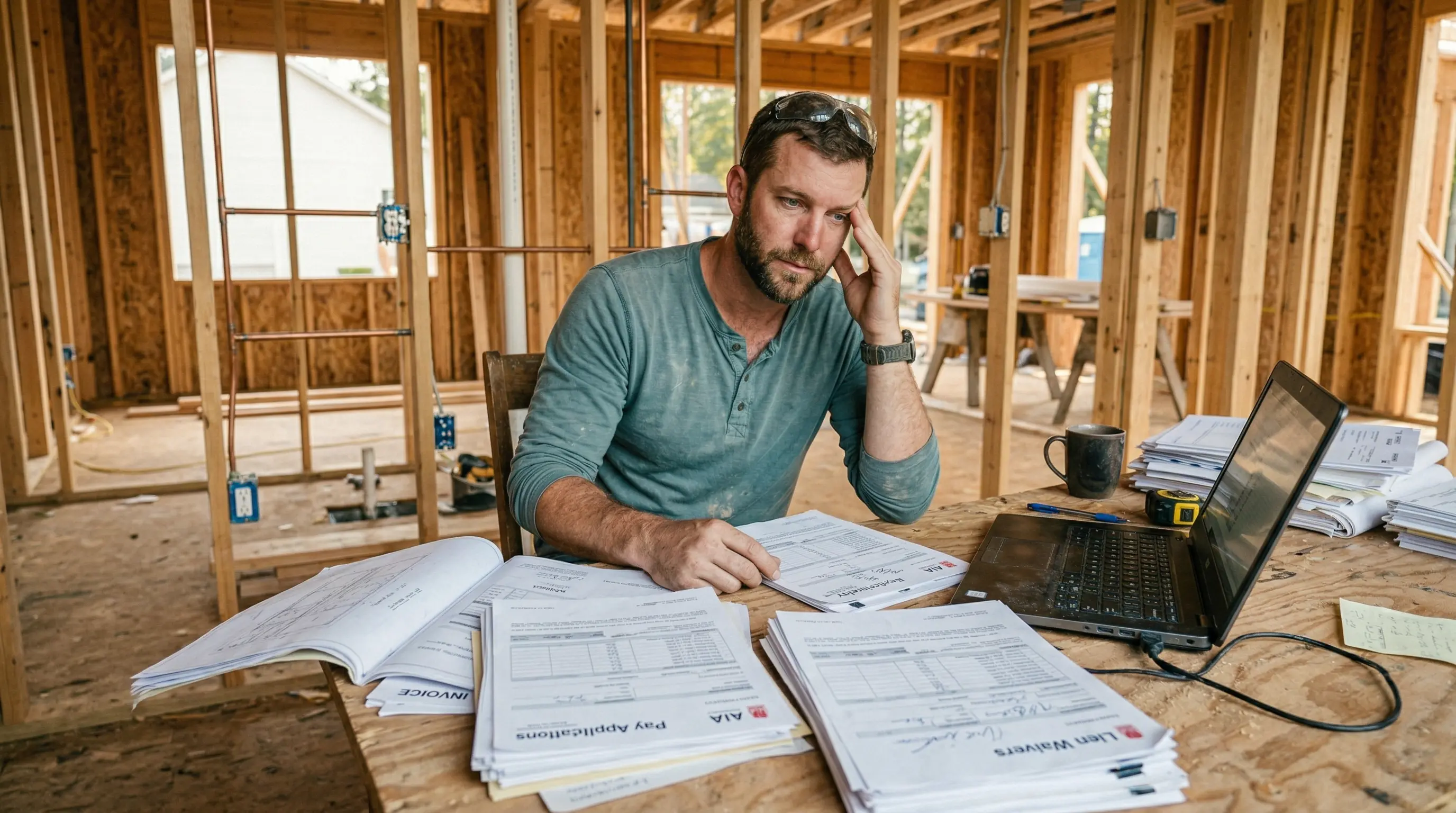
Let me tell you as a recovering GC: draw day was the day I dreaded most. Not because it's hard, exactly. Because it's tedious in a way that makes you question your career choices. You didn't get into construction to sit at a desk matching cost codes to invoices that a plumber texted you as a photo.
A draw package is the set of documents you submit to your lender to get funds released from a construction loan. It proves the work got done, the numbers add up, and nobody's going to slap a lien on the property. That's the 30-second version. The rest of this post is about why that simple concept eats so many hours, and what you can do about it.
What goes into a draw package?
A draw package (also called a draw request or pay application) includes every document your lender needs to verify that work was completed and costs are legitimate before releasing funds. The specifics vary by lender, but the core is the same.
You'll need a schedule of values showing your budget versus actual spend on each line item. You'll need the pay application itself, which most lenders want in AIA G702/G703 format — a standardized pair of forms the American Institute of Architects created that have somehow survived decades without a meaningful update. The G702 is the summary (contract value, change orders, retainage, amount due). The G703 is the line-by-line backup.
Behind that, you need subcontractor invoices for every line item you're billing, lien waivers from every sub and supplier who got paid in the prior period, change order documentation for anything that shifted the scope, and usually progress photos or inspection reports. The draw package can run anywhere from 20 pages on a simple renovation to 500+ documents on a large commercial project, according to Flex.one's draw request guide.
Some lenders want a single merged PDF ordered by cost code. Others want separate files. I've heard of banks that wanted hard copies mailed to a PO box — in 2019. The lack of standardization across lenders is a problem nobody talks about enough.
How much time does a draw package actually take?
For most GCs doing it manually, somewhere between 4 and 11 hours per draw, depending on project size, number of subs, and how organized your documentation is. Multiply that across your active projects and the number gets ugly fast.
FMI Corporation's research found that construction professionals spend more than 14 hours per week on non-optimal tasks — searching for files, resolving formatting issues, reconciling outdated documents. That's more than a third of the workweek lost to friction, and draw assembly is one of the biggest contributors.
The reasons are predictable if you've done this even once. Your plumbing sub sent a photo of a handwritten receipt. Your electrician emailed a PDF, but his cost codes don't match yours because he's used his own system for 30 years. Your framing crew submitted something that says "framing work — $14,800" with no line-item breakdown. Now you get to re-key all of that into your schedule of values, cross-reference cost codes, fill out the AIA forms, collect lien waivers (assuming you can reach the sub who's been ducking your calls for three days), and package it how your specific lender wants it.
When I ran my own crews, I tracked my time for one quarter. The number was 6.5 hours per draw across 4 active projects. That's 26 hours a month. I was essentially losing a full work week every month to paperwork that didn't earn me a dollar.
What happens when a draw gets rejected?
A rejected draw request delays your payment by 3 to 7 business days minimum while you fix the issue and resubmit. On a project with $40,000 in monthly draws, that's roughly $10,000 in labor and materials you're floating out of pocket while you wait.
And rejections are more common than most GCs want to admit. The typical culprits: a missing lien waiver from a lower-tier sub, a math discrepancy between the schedule of values and the invoices, an invoice the bank literally can't read because it's a photo taken at an angle in bad lighting. According to Mastt's construction draw guide, incomplete documentation is the primary cause of delayed construction draws, and the draw approval process takes a minimum of 5-7 business days even when everything is correct.
Scale that up and it gets serious. Dodge Construction Network reported in 2024 that 74% of construction companies experienced moderate to severe cash-flow challenges, with delayed payments being the most common cause. The Mobilization Funding 2025 Construction Delays and Payment Timing Report found that slow payments cost the industry a cumulative $280 billion in 2024 alone. Your rejected draw package isn't just an annoyance — it's a link in a chain that's choking the entire industry's cash flow.
I knew a GC in Charlotte who had three draws rejected in the same month across different projects. One was a missing lien waiver. One was a double-entered change order on the schedule of values. One was an unreadable invoice. He spent that entire week on draw corrections instead of jobsites. His superintendent ran two projects solo. That's not an edge case. That's a Tuesday in residential construction.
Why does every lender want something different?
There is no universal standard for draw package formatting, and that's one of the most expensive inefficiencies in construction finance. Each lender sets their own requirements for document order, file format, and supporting evidence.
Most lenders converge on the AIA G702/G703 as the pay application format — that's the closest thing to a standard the industry has. But the supporting documentation requirements are all over the map. One bank wants lien waivers sorted alphabetically by sub name. Another wants them organized by cost code. A third wants a summary cover sheet that nobody else requires.
This matters because a draw package that's perfect for Bank A might get kicked back by Bank B for formatting alone. If you're running five projects with three different lenders (which is normal for a GC doing $5M-$15M in annual revenue), you're maintaining three different assembly processes for functionally the same information.
McKinsey Global Institute ranks construction among the least digitized sectors in the world. In the U.S., it's second to last on their digitization index. The draw process is a case study in why: the information exists, but it's scattered across texts, emails, PDFs, photos, and handwritten notes, and the people who need it all want it formatted differently.
How to speed up your draw package process
The fastest fix is standardizing what you can control — your intake process and your documentation habits — before you think about software.
Give your subs one channel for invoices. Email alias, shared folder, portal, whatever. But pick one and enforce it. Half the chaos I've seen in draw assembly comes from invoices arriving via text, email, voicemail, and occasionally crumpled envelopes handed to you on the jobsite. One channel.
Write down your lender's exact requirements before you start a project. Format, document order, supporting docs, everything. Tape it to your monitor. Better yet, put it in your draw software. FMI Corporation found that poor document control is responsible for 48% of all rework in construction, costing roughly 9% of total project costs. A 5-minute call to your lender at project kickoff can prevent a week of rework later.
Collect lien waivers in real time, not at draw time. If you wait until you're assembling the draw to chase waivers, you're guaranteed to be missing at least one. 12 states (including Texas, California, Florida, and Arizona) have statutory lien waiver requirements — using non-compliant forms in those states can invalidate your lien rights entirely.
Beyond process fixes, the structural problem remains: you're still the translator between your subs' chaos and your lender's rigidity. That translation layer is what Trade Agent was built to eliminate. Subs upload invoices through a portal. The system reads each invoice, maps line items to cost codes, flags duplicates and missing waivers, and assembles the draw package in the format your lender expects. You review instead of rebuilding from scratch.
We're in early access with GCs who were spending 4+ hours per draw. They're down to minutes. If you want to see how it works, check out the demo.
---
Frequently Asked Questions
What is included in a draw package?
A draw package includes a pay application (usually AIA G702/G703), schedule of values, subcontractor invoices, lien waivers, change order documentation, and progress photos. Requirements vary by lender.
How long does it take to get a construction draw approved?
Most lenders take 5-7 business days to approve a draw request after submission, assuming no documentation issues. Rejected draws add another 3-7 days per resubmission cycle.
What is the difference between a draw request and a pay application?
They're often used interchangeably. A pay application (AIA G702) is the specific form requesting payment. A draw request is the broader package that includes the pay application plus all supporting documentation.
Why do draw requests get rejected?
The most common reasons are missing lien waivers, math discrepancies between the schedule of values and invoices, incomplete backup documentation, and formatting that doesn't match the lender's requirements.
How often can you submit a draw request?
Frequency depends on your loan agreement. Most construction loans allow monthly draws tied to the billing cycle, but some allow milestone-based draws at project phase completion.
Do subcontractors submit draw packages?
Subs submit invoices and lien waivers to the GC, who assembles them into the draw package for the lender. Subs don't typically interact with the lender directly on draws.
What is AIA G702 and G703?
G702 is the Application and Certificate for Payment, summarizing the total contract value, work completed, retainage, and amount due. G703 is the Continuation Sheet, which breaks the billing down line by line against the schedule of values. Together they're the standard pay application format most lenders require.
How can I reduce the time I spend on draw packages?
Standardize your invoice intake to one channel, collect lien waivers in real time instead of at draw time, document your lender's formatting requirements upfront, and consider tools like [Trade Agent](https://www.thetradeagent.com) that automate the assembly process from invoice to draw.