
General Contracting
9 Scheduling Bottlenecks That Are Secretly Costing Your Small Trade Business a Fortune
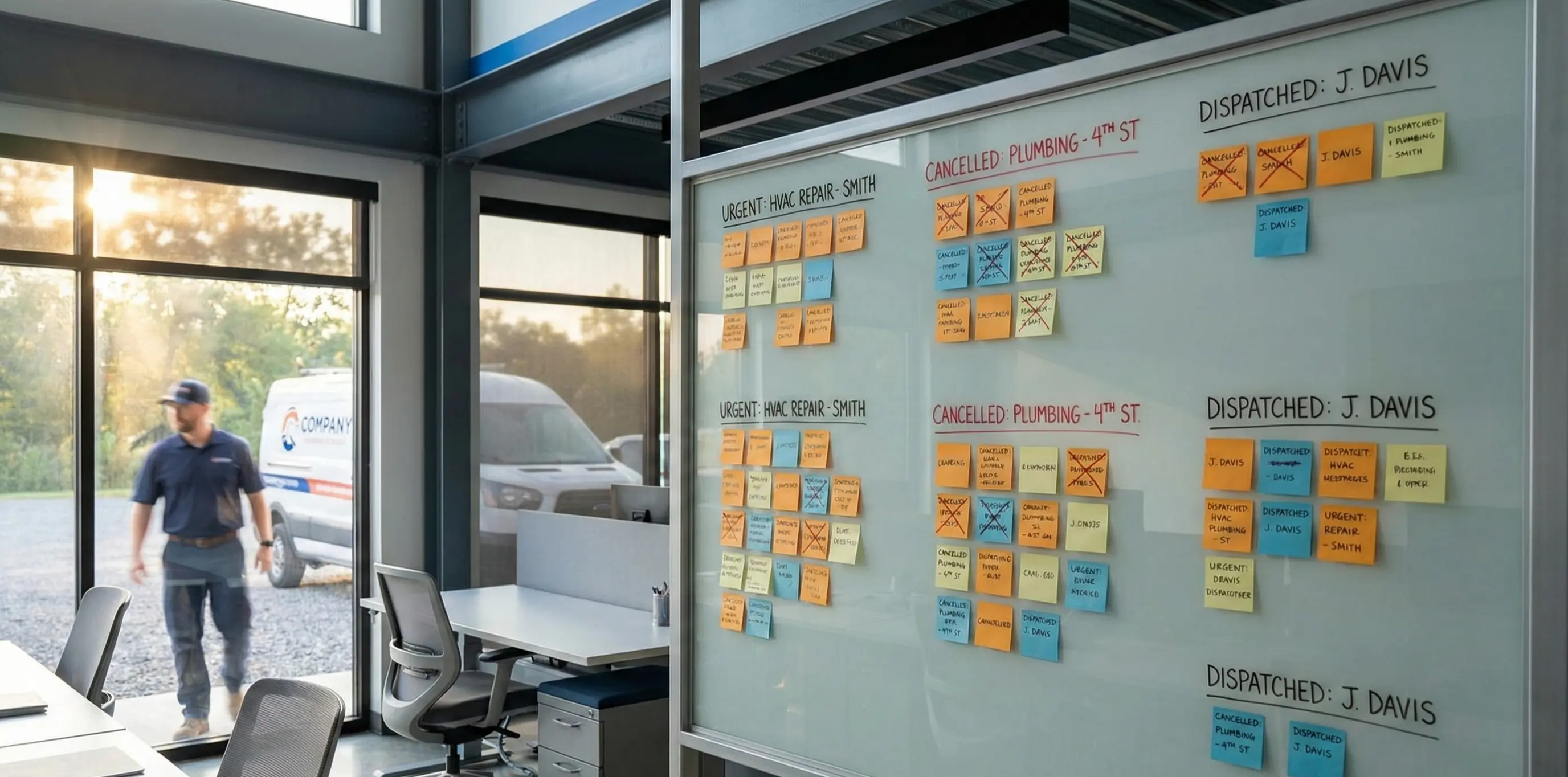
You're Wasting Time and Money
If you're running a trade business with 5-25 employees, you already know that time is your most valuable—and most finite—resource. Every minute your techs spend waiting, backtracking, or untangling scheduling conflicts is a minute they're not generating revenue.
The problem? Most scheduling bottlenecks are invisible. They don't show up as line items on your P&L. They hide in the gaps between jobs, in the extra miles driven across town, and in the callbacks that eat your margins alive. These inefficiencies compound daily, creating a slow drain that's difficult to detect but devastating to your bottom line.
This isn't about working harder. It's about identifying the specific friction points in your scheduling system and systematically eliminating them. In this guide, we'll break down nine scheduling bottlenecks that are silently costing your trade business a fortune—and more importantly, how to fix them.
The Hidden Cost of Scheduling Chaos
Before diving into specific bottlenecks, let's understand the scope of the problem. According to research from FMI, contractors believe 11-15% of their field labor costs are wasted or unproductive. More critically, they estimate that 6-10% of labor spending could be saved through better management practices alone.
For a trade business generating $500,000 in annual revenue with 35% going to labor, that's potentially $17,500 to $30,000 in recoverable losses—just from improving how you schedule and dispatch work.
The data is clear: scheduling isn't just an operational detail. It's a profit lever.
Bottleneck #1: The Cross-Town Shuffle
Your techs are crisscrossing your service area like they're competing in some kind of urban orienteering competition. One job in the north suburbs, the next one downtown, then back out east. Sound familiar?
According to research on field service optimization, average travel time can be reduced by 16.2% with proper route optimization—that's 10 minutes saved for every hour of travel. For a tech making four service calls per day, that adds up to 40 minutes of reclaimed productive time daily.
The fix: Group jobs geographically when scheduling. Even basic zone-based dispatching can cut fuel costs and add one extra job per tech per day. The admin burden alone costs trade businesses 14+ hours weekly—route optimization is one of the fastest ways to claw back some of that time.
Bottleneck #2: The Callback Death Spiral
Every callback is a double hit: you're paying a tech to redo work that should've been right the first time, AND you're losing the revenue that tech could have generated on a paying job.
ACCA's research breaks down the math: at a 5% callback rate (more common than most contractors want to admit), each service callback costs approximately $650 when you factor in tech time, admin overhead, and lost opportunity cost. Install callbacks jump to $850 each. For a mid-sized contractor running 2,200 service calls and 200 installs annually, that's $80,000 per year vanishing into rework.
The fix: Build quality checkpoints into your scheduling workflow. When callbacks become scheduling events—tracked, measured, and analyzed—you can identify patterns. Is it a specific tech? A particular type of job? A training gap? General contractors lose $47K per year to bid variance—callbacks create the same kind of margin erosion for service businesses.
Bottleneck #3: The Skills Mismatch
You dispatch your best diagnostic tech to a routine maintenance call while your apprentice struggles through a complex troubleshooting job that requires senior expertise. The result? Your A-player is underutilized, your customer with the complex problem is frustrated, and you've burned hours on both ends.
According to electrical contractor research, inefficient scheduling practices cost an average of 1-2 hours per worker per week in delays alone—approximately $7,800 in annual losses per employee.
The fix: Tag jobs by complexity and skill requirements at the scheduling stage, not as an afterthought. Your scheduling system should match job requirements to technician capabilities automatically. A senior tech on a junior job is wasted capacity. A junior tech on a senior job is a callback waiting to happen.
Bottleneck #4: The Buffer Bloat
Here's a scenario that plays out constantly: Your electrician estimates a job will take four hours, so he blocks off five to give himself breathing room. The drywall sub does the same thing. Pretty soon, everyone's padding their estimates, and as one construction executive explained to Construction Dive, "If you take two out of five days as not entirely necessary, that's 40% waste right there."
This isn't malicious—it's self-preservation. Techs pad estimates because they've been burned by unpredictable jobs before. But when everyone buffers, the schedule becomes fiction.
The fix: Track actual job duration against estimates religiously. Over time, you'll build accurate benchmarks that reduce the need for defensive padding. When techs trust the schedule, they stop protecting themselves from it.
Bottleneck #5: The Communication Black Hole
A customer cancels. Your office knows. Your tech doesn't. He drives 20 minutes to an empty house, then has to scramble to fill the gap.
Or worse: a job runs long, but no one updates the afternoon appointments. Now you've got three angry customers wondering where their technician is, and your phones are ringing off the hook with complaints instead of new business.
Research shows that U.S. office workers are interrupted up to 11 times per hour. In a trade business context, many of those interruptions are schedule-related fires that could have been prevented with better real-time communication.
The fix: Implement real-time status updates that flow automatically between field and office. When a job runs long, the system should flag downstream appointments immediately. When a cancellation hits, the nearest available tech should know within minutes, not hours.
Bottleneck #6: The Feast-or-Famine Cycle
Monday morning, your schedule is packed. By Wednesday afternoon, tumbleweeds. Then Thursday explodes with emergency calls you can barely handle.
This volatility isn't just stressful—it's expensive. During slow periods, you're paying techs to wait. During rush periods, you're either turning away work or burning through overtime.
According to the Construction Industry Institute, only approximately 25% of construction projects are finished on schedule without timing deviations. For service businesses, the challenge is similar: demand is inherently unpredictable, but your labor costs are fixed.
The fix: Analyze your scheduling patterns over 90 days. You'll likely discover predictable rhythms—seasonal peaks, slow days of the week, customer behavior patterns. Use that data to proactively fill gaps with maintenance agreements, follow-up calls, or marketing pushes timed to slow periods.
Bottleneck #7: The Estimate-to-Schedule Disconnect
Your estimate says the job takes three hours. Your schedule blocks two. Now your tech is rushing through work to stay "on time," cutting corners that'll come back as callbacks, or running late and torpedoing the rest of the day's appointments.
This disconnect usually happens because estimating and scheduling live in separate systems—or separate people's heads. The information doesn't flow cleanly from quote to calendar.
The fix: Integrate your estimating and scheduling workflows so that job duration automatically populates from the estimate. AI-powered systems like those used for complex HVAC calculations can dramatically improve estimate accuracy, which cascades into more reliable scheduling.
Bottleneck #8: The Last-Minute Scramble
Emergency calls are part of the business. But when "emergency" becomes your default operating mode, something's broken.
Constant firefighting means your carefully planned schedule gets blown up daily. Techs get pulled off scheduled work. Customers who booked in advance get bumped. Your dispatcher spends more time rescheduling than scheduling.
FMI's productivity research found that projects falling behind early rarely make miraculous recoveries. The same principle applies to daily schedules: once you're reactive, you stay reactive.
The fix: Build emergency capacity into your schedule deliberately. Reserve 10-15% of daily capacity for urgent calls instead of booking at 100% and hoping for the best. It feels counterintuitive—like leaving money on the table—but the alternative is chaos that costs you more in the long run.
Bottleneck #9: The Invisible Tech
You don't know where your techs are. You don't know if they're on schedule, running behind, or finished early. You don't know if that 2:00 PM appointment is happening or if your customer is currently leaving you a one-star review.
This visibility gap creates a cascade of problems: you can't redirect resources dynamically, you can't give customers accurate ETAs, and you can't identify inefficiencies because you can't see them.
According to Autodesk's construction industry research, 82% of owners feel they need more collaboration with their contractors. For your customers, that collaboration starts with simply knowing when you'll show up—and being right about it.
The fix: Implement GPS tracking and job status updates that give you real-time visibility into your operation. Not to micromanage—to optimize. When you can see the whole board, you can make smarter moves.
How Trade Agent Eliminates Scheduling Bottlenecks
Every bottleneck we've discussed shares a common root cause: disconnected information. Estimates don't talk to schedules. Schedules don't talk to techs. Techs don't talk to the office in real time. Customer expectations don't align with operational reality.
Trade Agent was built to solve exactly this problem. Our AI assistant Arti doesn't just help you create estimates faster—it connects those estimates directly to your scheduling workflow, ensuring job durations are accurate from the start. Real-time visibility keeps everyone on the same page. And intelligent scheduling recommendations help you optimize routes, match skills to jobs, and build in the right amount of buffer without bloating your day.
The result? Trade businesses using AI-powered scheduling tools report completing one extra job per tech per day. At average ticket prices, that's thousands in additional monthly revenue—without adding headcount or overtime.
Conclusion
Scheduling bottlenecks are profit leaks. They don't announce themselves—they accumulate silently until you're wondering why your revenue isn't translating into margin.
The good news? These are solvable problems. Every bottleneck we've covered has a fix, and most of those fixes don't require massive investments or operational overhauls. They require visibility, integration, and a willingness to treat scheduling as the strategic function it actually is.
Start by picking one bottleneck—the one that resonates most with your current pain points—and address it systematically. Measure before and after. Then move to the next one.
Ready to see how much scheduling inefficiency is really costing your trade business? Start your free Trade Agent trial and let Arti analyze your workflow for optimization opportunities.
FAQ
Q: How much time do contractors actually waste on scheduling-related inefficiencies?
A: Research suggests trade businesses lose 10-15 hours per week to administrative tasks, with scheduling and coordination representing a significant portion of that time. Route inefficiencies alone can cost 1-2 hours per tech per day in unnecessary travel.
Q: What's the fastest way to reduce scheduling bottlenecks without new software?
A: Start with geographic clustering—group jobs by location rather than booking them in the order requests come in. This single change can add one extra job per tech per day while reducing fuel costs and windshield time.
Q: How do I calculate the actual cost of callbacks for my business?
A: Factor in the tech's time (typically 2-3 hours), your office overhead for that period, and most importantly, the lost opportunity cost—the revenue that tech could have generated on a paying job. For most trade businesses, each callback costs $500-$850 when fully accounted for.
Q: Should I schedule at 100% capacity to maximize revenue?
A: No. Building in 10-15% emergency capacity actually increases revenue by reducing the chaos that comes from constant rescheduling. A predictable 85% is more profitable than a chaotic 100%.
Q: How can AI help with contractor scheduling?
A: AI-powered scheduling tools can optimize routes automatically, match job complexity to technician skill levels, predict job durations more accurately based on historical data, and provide real-time visibility that enables dynamic adjustments throughout the day.


Similar posts





Book Your Demo


