
Electrical
How Subcontractors Can Win More Bids Without Working Weekends
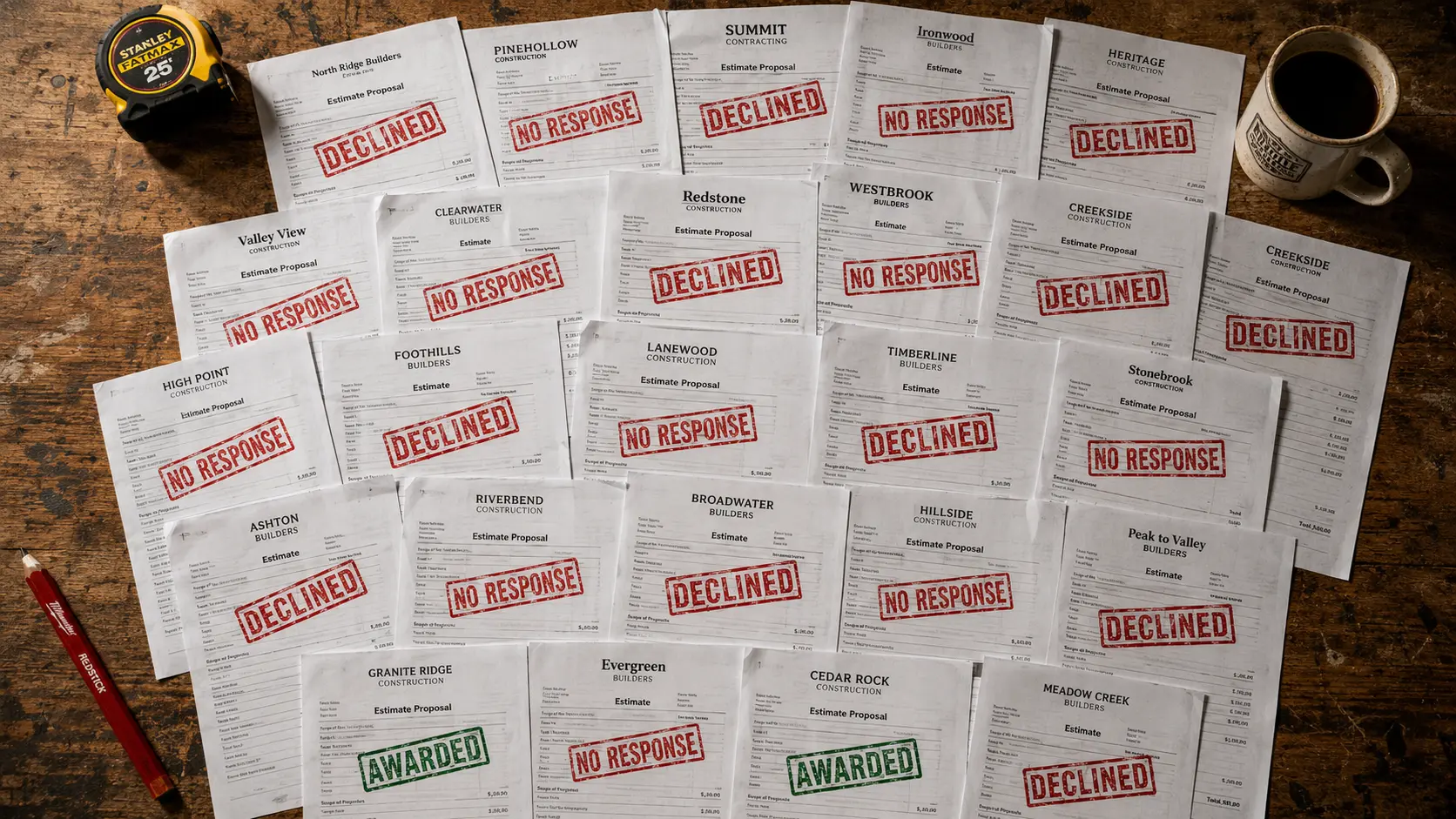
You're the owner. You're also the estimator. On Tuesday night you're hunched over a laptop pricing a bathroom remodel that came in at 4pm, because if you don't send it by tomorrow morning someone else will. According to AGC and industry survey data compiled by AgentZap, 78% of construction clients award projects to the first contractor who provides a live response. Not the cheapest. Not the most experienced. The first one who picks up and says “I can do that.”
If you're reading a typical subcontractor estimating tips article, this is where they'd tell you to “be more organized” or “use better templates.” But you don't need better estimates. You need more of them, and you need them before the GC forgets who you are.
Why Is the Owner Always the Bottleneck?
Because nobody else in a 3-15 person shop knows the work well enough to price it.
This is the part that the “hire an estimator” advice always glosses over. At $5M-$10M in revenue, an experienced construction estimator costs $65,000-$80,000 per year. At $1M-$3M, that salary doesn't exist in the budget. So the owner does it. Evenings. Weekends. Between running crews and answering the phone and chasing payments.
Well Built Construction Consulting frames it as a bottleneck problem: when estimating bandwidth becomes the constraint, everything else in the business waits. The estimating hours crowd out everything else. Marketing. Relationship building. The site visits that turn into referrals. The follow-up calls that close repeat work.
And the math is brutal. If each estimate takes 2-4 hours and you can carve out 10-12 estimating hours per week around actually running the business, you're producing 3-5 bids per week. That's maybe 150-200 bids per year.
What Does It Actually Cost to Bid on a Job You Don't Win?
More than most subs ever calculate.
Togal.AI's analysis of estimating economics found that material takeoffs alone average 7 days of work, cost estimation adds another 12 days, and a single proposal costs over $5,376 in estimator labor. That number skews commercial, but even at half that rate for residential sub work, you're looking at $2,500+ per bid attempt in the owner's time.
Now apply the win rate. Industry data from ENR and Four BT shows that subcontractors on private bid work win about 1 in 5. Public work is worse, 1 in 7 to 1 in 11. Less than 6% of construction companies even track their bid-hit ratio, which means most subs are flying blind on this number.
So if you're winning 1 in 5 and spending $2,500 per bid attempt, you're paying $12,500 in estimating time for every job you land. On a $30,000 project with 15% margins, that's $4,500 in profit. You just spent $12,500 in time to earn $4,500. The math only works if you pretend your weekends are free.
I spent two years not tracking this. When I finally did, I stopped bidding municipal work entirely. The hit rate was so low that every win was actually a loss when I counted the hours I'd sunk into the nine proposals that went nowhere.
Does Responding Faster Actually Win More Bids?
The data says yes, overwhelmingly.
Research compiled from AGC and ABC surveys found that contractors who respond within 5 minutes are 391% more likely to convert a lead into a project. Wait 30 minutes and your chances drop by a factor of 21. And 91% of clients expect a response within 4 hours.
Nobody expects a finished estimate in 5 minutes. But being the sub who calls back immediately, asks two smart questions, and says “I'll have a number for you by end of day.” The GC or homeowner who sent that bid request to four subs is going to go with the one who made them feel like a priority.
For subs, speed compounds in a way that accuracy doesn't. A slightly imperfect estimate delivered in 24 hours beats a perfect one delivered in 5 days. The GC has already shortlisted vendors by the time your polished PDF lands. This is especially true in the residential remodel market where homeowners are comparing 2-3 bids and going with whoever feels most responsive and professional.
ServiceTitan's 2026 Commercial Specialty Contractor Industry Report found that more than three-quarters of contractors are sitting on at least 9 months of secured work, with 41% carrying over a year of backlog. When everyone is busy, the sub who can turn a bid around fastest gets first pick of the best projects.
What's the Estimating Ceiling and How Do You Break It?
The estimating ceiling is the maximum number of bids you can produce given the hours available. For most sub owners, it's somewhere around 150-200 per year. Your revenue can't grow beyond what that bid volume, multiplied by your win rate, multiplied by your average project value, produces.
Say you bid 180 jobs per year, win 20% (36 jobs), and your average project is $25,000. That's $900,000 in revenue. To hit $1.5M, you need to either win bigger jobs, improve your hit rate, or bid more. The first two take years of relationship building. Bidding more is the only thing you can change this quarter.
A few ways to break the ceiling without adding staff:
Bid faster, not better. Cut estimating time per bid from 3 hours to 1 hour, and you produce 3x the volume in the same weekly time block. That means being honest about which bids need detailed takeoffs and which can be priced from experience and historical data. Not every $8,000 service call needs a 3-hour estimate.
Stop bidding jobs you won't win. DownToBid's analysis recommends tracking your bid-hit ratio by project type, GC relationship, and geography. If you're winning 5% on public hospital work and 35% on residential remodels through your three best GC relationships, spend your hours where the math works. A 5:1 hit ratio is the industry benchmark for a healthy pipeline. Anything worse than 8:1 deserves scrutiny.
Use AI to handle the repetitive parts. This is where the industry is moving, even if slowly. ServiceTitan's 2026 report (with Thrive Analytics) found that 24% of contractors now apply AI to cost estimation and budgeting, and contractors reporting measurable AI business impact more than doubled from 17% in 2025 to 38% in 2026. Grand View Research projects the construction estimating software market will reach $2.62B by 2030, growing at 10.2% CAGR — with the contractors segment as the fastest-growing end-use category.
The early-mover window is wide open. An analysis from Dan Cumberland Labs summarizing independent testing of AI estimating platforms in February 2026 found 97-99% accuracy with 1.8-4% error rates. Companies using AI-led estimating pipelines reported 310% higher bid win rates and the ability to bid 2-3x more projects without expanding headcount.
How Does AI Estimating Actually Work for a Sub?
It's not a magic box. You still need to know your numbers.
The workflow for most AI estimating tools goes something like this: you upload a photo of the job, or a set of plans, or you describe the scope by voice. The AI generates a material takeoff and labor estimate based on local pricing data, your historical costs, and the scope description. You review it, adjust for the stuff only you know (that GC always adds scope, that neighborhood has terrible parking, the permit office takes three weeks), and send.
Trade Agent's AI, Arti, handles this on mobile. Snap a photo of the job, describe what you see, and Arti builds the estimate with line items, material quantities, and labor hours. You tweak what needs tweaking and send it from your truck before the next sub even opens their laptop.
The key is that AI handles the 70% of estimating that's mechanical — measurements, material lookups, standard labor rates — so the owner can focus on the 30% that requires actual expertise: site conditions, relationship pricing, risk assessment. The spreadsheet work gets automated. The judgment stays with you.
For a 10-person electrical shop doing 150 bids per year, compressing estimate time from 3 hours to 45 minutes means the owner gets back roughly 340 hours per year. That's eight and a half 40-hour work weeks. That's the weekends back. Or it's another 350 bids at the faster rate, which at a 20% hit rate means 70 more won jobs.
What About Estimate Quality? Does Speed Sacrifice Accuracy?
This is the objection every experienced sub raises, and for good reason.
If faster meant sloppier, it wouldn't help. You'd just be losing money on more jobs instead of fewer. But the data doesn't support that tradeoff anymore. Dan Cumberland Labs' analysis found that AI estimating tools produce 97-99% accuracy, compared to 90-95% for manual estimates. And the same analysis cites research showing 88% of spreadsheets contain formula errors.
I've seen this play out with HVAC guys specifically. The owner who prices every job by hand from a mental database of material costs is accurate for the jobs he does every week. But when a new scope comes in, say a geothermal system or a commercial kitchen hood, the manual estimate is just a guess with better formatting. AI pulls from actual supplier pricing and regional labor data for scopes the estimator hasn't personally done 50 times.
The accuracy floor goes up and the time drops. AI handles the data collection. You handle the decisions.
The subs who move early on this get first look at the best jobs before they hit open bid. And when everyone else is busy (which, with three-quarters of contractors carrying 9+ months of backlog, is right now), the sub who bids fastest picks the most profitable work off the top.
What Else Can Subs Do With the Time They Get Back?
I never see this question asked in "subcontractor estimating tips” articles.
If the owner reclaims 6-8 hours per week from estimating, that's not “free time.” That's capacity for the work that actually grows a sub business: following up with GCs who haven't sent work in 90 days, visiting jobsites to build relationships with PMs who control the bid lists, reviewing financials instead of guessing at cash flow, and training the crew member who could eventually take over estimating.
BLS data shows that 64.1% of construction businesses started since 2011 didn't survive to 2022. The subs that make it past year 5 are the ones who figured out how to build a business around the work instead of only doing the work. When the owner is stuck in the estimating chair every evening, the business isn't growing. It's just surviving on the owner's ability to outwork the calendar.
Frequently Asked Questions
How long should a construction estimate take a subcontractor?
For residential sub work, 1-3 hours is typical for manual estimates. AI-assisted estimating can compress this to 15-45 minutes depending on scope complexity, per Dan Cumberland Labs' analysis.
What is a good bid win rate for subcontractors?
Industry benchmarks from ENR put healthy sub bid-hit ratios at 5:1 for private work (20%). Public bid work runs 7:1 to 11:1. Track yours by project type and GC relationship.
How much does a losing construction bid cost?
Estimator labor alone runs $2,500-$5,300+ per bid attempt, per Togal.AI research. At a 20% win rate, that's $12,500-$26,500 in time invested per won job.
Can AI replace a human estimator for construction bids?
No. AI handles the mechanical 70% (takeoffs, material lookups, labor rate calculations) at 97-99% accuracy. The owner still provides judgment on site conditions, relationship pricing, and risk.
How do subcontractors grow revenue without hiring more estimators?
Break the estimating ceiling by bidding faster (not better), dropping low-hit-rate project types, and using AI tools to multiply bid volume. Compressing 3-hour estimates to 45 minutes lets a single owner produce 3-4x more bids.
Does responding faster to bid requests actually help subcontractors win?
Yes. Industry data shows contractors who respond within 5 minutes are 391% more likely to convert, and 78% of clients award to the first responder.
What should subcontractors look for in AI estimating software?
Photo-to-estimate capability, local material pricing data, integration with your invoicing/CRM, and the ability to adjust AI outputs with your own judgment. Avoid tools that require extensive training or can't handle your specific trade.


Similar posts

Book Your Demo


