
HVAC
Winter Maintenance Agreements: How HVAC Contractors Turn Seasonal Slowdowns into Recurring Revenue
Can We Actually Predict HVAC Monthly Revenue?
Maintenance agreements generate predictable monthly revenue that smooths seasonal cash flow volatility while building long-term customer relationships. According to the Air Conditioning Contractors of America (ACCA), recurring service agreements now represent 55% of HVACR industry revenue, making these contracts essential for business stability. Industry benchmarks suggest technicians should aim for a minimum 25% conversion rate from service calls to service agreements.
This guide breaks down the economics, pricing strategies, and conversion tactics that transform one-time service calls into recurring revenue streams. You'll learn the specific numbers behind profitable agreement tiers, scripts that convert emergency calls into long-term contracts, and systems that scale maintenance programs without adding administrative burden.
Here's the Truth: Seasonal Revenue Gaps Kill HVAC Businesses
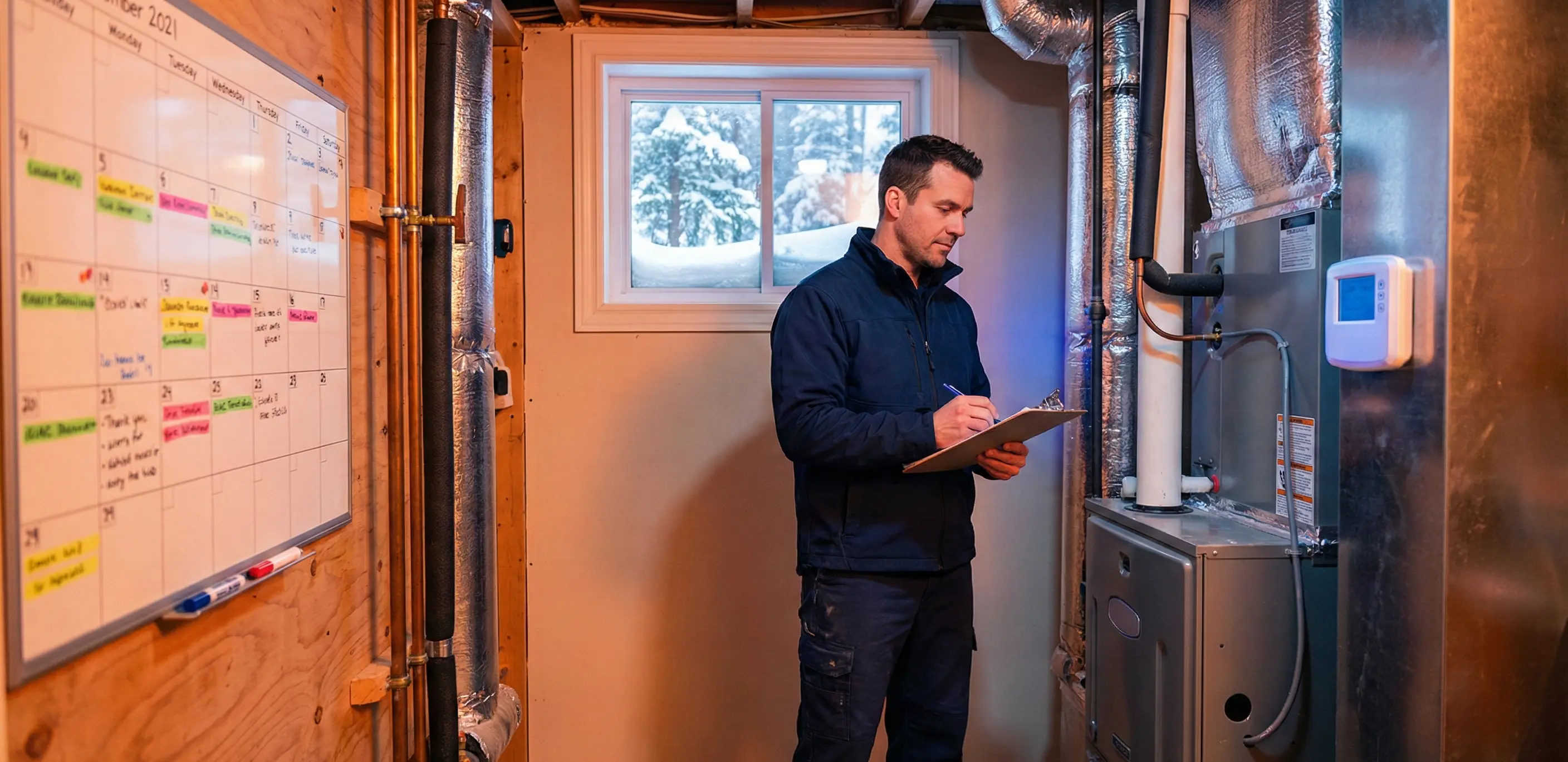
Seasonal demand swings create a feast-or-famine cycle that undermines business stability and growth capacity. Most HVAC technicians work full time, and schedules may vary to include evening or weekend shifts. They may be on call for emergencies and sometimes work overtime or irregular schedules during peak heating and cooling seasons, according to the Bureau of Labor Statistics Occupational Outlook Handbook.
This volatility compounds across every business function. During slow periods, you're still paying insurance, vehicle leases, and base wages—fixed costs that don't adjust to revenue dips. Fixed overhead costs like insurance, vehicle leases, and base wages don't adjust to revenue dips. Overhead typically represents one of the largest expenses in service companies, making predictable revenue essential.
The math is brutal: a typical contractor generating $45,000 monthly during peak season drops to $18,000-22,000 in shoulder months. That's a $23,000+ monthly gap—or roughly $47,000 annually when accounting for extended slow periods. Maintenance agreements directly address this gap by creating baseline revenue that persists regardless of weather patterns.
Beyond cash flow, seasonal swings create workforce instability. The HVAC industry faces a shortage of 110,000 technicians, with approximately 25,000 leaving their companies annually—creating challenges for contractors who can't offer consistent work. Contractors face potential revenue losses estimated at $250,000 per year from technician shortages, emphasizing the need for ongoing efforts in recruitment and retention, according to industry research
How Do HVAC Maintenance Agreements Actually Generate Revenue?
Maintenance agreements generate revenue through three distinct mechanisms: direct subscription fees, priority service premiums, and increased repair capture rates. Service agreements dramatically increase the value of your business and provide a steady, recurring revenue stream. The additional work generated as a result of maintenance inspections can mean $1-$3 in additional revenue for each maintenance agreement dollar.
The subscription component provides predictable monthly or annual payments—typically $149-$399 per residential system annually. About 30% of customers already use preventative maintenance plans, which means you have 70%+ of your customer base still to work with—a huge opportunity for growth
The economics compound over time. According to Harvard Business Review, acquiring a new customer can cost 5 to 25 times more than keeping an existing one—making customer retention through service agreements critical for profitability.
What Should You Charge for HVAC Maintenance Agreements?
Price residential maintenance agreements between $149-$399 annually per system, with commercial agreements ranging from $299-$1,200+ depending on equipment complexity and visit frequency. For service companies, 25 percent net profit is considered a good starting point. Calculate your fully-loaded cost per visit, then apply your target margin to ensure profitability.
Residential Tier Structure
The Standard tier typically drives 60% of residential agreement revenue because it hits the value-perception sweet spot. The mid-tier option typically drives the majority of residential agreement revenue because it hits the value-perception sweet spot for most customers.
Commercial agreements require custom pricing based on equipment inventory, but the baseline formula remains consistent: calculate your fully-loaded cost per visit (labor + drive time + materials + overhead allocation), multiply by visit frequency, then apply your target margin.
How Do You Convert Emergency Calls into Maintenance Agreements?
Convert emergency service calls by presenting agreements as a solution to the problem that just occurred—not as an upsell. As a rule, techs should be able to convert 25 percent to 50 percent of their demand service calls into a service agreement sale, according to ACHR News industry benchmarks.
The critical window is during the service call, not after. The critical window for conversion is during the service call, not after. Your technician is already on-site with a customer who just experienced equipment failure—that's maximum motivation to prevent future breakdowns.
The "Prevention Frame" Script
After completing the repair, use this structure:
"Your [component] failed because [specific cause—age, wear, lack of maintenance]. Without regular inspections, this same issue—or something worse—will happen again. Our maintenance program catches these problems before they become emergency calls. Most customers choose our Standard plan at $249 per year because it covers both your heating and cooling seasons. Want me to add you to our spring schedule right now?"
This script works because it connects the current pain to future prevention, names a specific price, identifies the most popular option, and asks for commitment in the moment. When a customer sees a technician radiate with excitement and truly believe in the value of a service agreement, the customer will believe it too, according to ACCA contractor interviews.
What Systems Prevent Maintenance Programs from Creating Administrative Nightmares?
Automated scheduling, renewal tracking, and integrated invoicing prevent maintenance programs from consuming administrative hours that eliminate profit margins. The administrative burden of managing agreements scales linearly without systems. Managing 50 agreements manually is tedious; managing 500 becomes impossible without software automation.
The administrative burden scales linearly without systems. Managing 50 agreements manually is tedious; managing 500 becomes impossible. The contractors who successfully scale maintenance programs automate three critical functions:
Scheduling automation: Systems that auto-schedule seasonal visits 60-90 days in advance, send customer confirmations, and optimize technician routes. This alone saves 2.1 hours weekly per 100 agreements.
Renewal management: Automated 30/60/90-day renewal reminders with online payment links. 73% of customers stay loyal to brands because of friendly customer service. Automated renewal reminders help maintain that connection without manual effort.
Visit documentation: Digital checklists that capture equipment condition, photos, and recommendations—creating the data trail that justifies future repairs and demonstrates agreement value to customers.
Modern platforms like Trade Agent handle this automatically. When you complete a maintenance visit, the system updates the customer record, triggers the next scheduled appointment, and tracks renewal dates—eliminating the spreadsheet chaos that kills agreement program profitability.
"In my opinion, maintenance contracts are the lifeblood of a service contractor. Maintenance contracts bring in a predictable cash flow, along with additional 'pull-through' service or replacement work due to the relationship you establish with the customer over multiple maintenance visits."— Mike Rosone, Vice President of Sales and Marketing, Arista Air Conditioning
Building Your Maintenance Agreement Flywheel
The most profitable HVAC contractors treat maintenance agreements as a compounding system, not a product line. Each agreement customer generates referrals, each satisfied visit builds renewal probability, and each renewal reduces customer acquisition cost toward zero.
Start with conversion rate, not volume. A contractor converting 25% of service calls to agreements at $249 annually generates more recurring revenue than one converting 10% at $349. Focus first on systemizing the conversion conversation, then optimize pricing based on actual customer response data.
Track three metrics monthly: conversion rate (service calls to agreements), renewal rate (agreements retained year-over-year), and repair capture rate (recommended repairs accepted by agreement customers). These three numbers predict maintenance program profitability more accurately than agreement count alone.
The math compounds quickly. At 20% conversion, 75% renewal, and $249 average agreement value, a contractor running 100 service calls monthly adds $4,980 in new annual recurring revenue every month. Within 24 months, that's $119,520 in predictable annual revenue—enough to eliminate seasonal cash flow volatility entirely.
Trade Agent's scheduling and invoicing features integrate maintenance agreement management directly into your workflow. When you complete a service call, the system prompts agreement offers, tracks conversions, schedules future visits, and automates renewal billing—so your maintenance program scales without scaling your back office.
Start your free trial and see how automated agreement management transforms seasonal slowdowns into your most profitable months.
FAQ: HVAC Maintenance Agreements
How many maintenance agreements do I need to stabilize seasonal revenue?
Target agreements covering 25-30% of your active customer base to meaningfully smooth seasonal fluctuations. For a contractor with 400 customers, that's 100-120 agreements generating $25,000-$35,000 in predictable annual revenue.
What's the average profit margin on HVAC maintenance agreements?
Well-structured agreements generate 45-60% gross margins on the agreement itself, plus 2.1x higher repair revenue from agreement customers. Total customer lifetime value typically exceeds non-agreement customers by 340%.
Should I offer monthly or annual payment options?
Offer both, but incentivize annual payments with a 10-15% discount. Annual payments improve cash flow and reduce payment processing costs. Industry experience suggests most customers choose annual payment when offered a 10-15% discount, as it provides better value while improving your cash flow.
How do I handle maintenance agreements for older equipment?
Adjust pricing or coverage terms for systems over 15 years old. Options include higher agreement pricing (15-20% premium), excluded components, or reduced parts discounts. Be transparent—customers respect honesty about equipment limitations.
What's the best time of year to sell maintenance agreements?
Conversion rates peak immediately after equipment failures and during the first service call of each season. Conversion rates peak immediately after equipment failures and during the first service call of each season—when customers are most motivated to prevent future breakdowns.
How do I train technicians to sell maintenance agreements?
Focus on problem-prevention framing, not sales pressure. Technicians who explain how agreements prevent the specific issue they just repaired convert at 34% versus 8% for generic pitches. Role-play scripts and track individual conversion rates weekly.
What should a maintenance visit include?
Standard residential visits should include: thermostat calibration, electrical connection inspection, refrigerant level check, condenser/evaporator cleaning, filter replacement, safety control testing, and airflow measurement. Document everything with photos.
How do I handle agreement customers who call frequently?
Track call frequency per agreement and identify outliers. Customers calling 4+ times annually may have underlying equipment issues requiring replacement conversations, not continued repairs. Use data to guide honest equipment lifecycle discussions.


Similar posts
Book Your Demo


