
Electrical
Standby Generator Installations: How Electricians Can Quote Whole-Home Backup Systems for Maximum Profit
The Problem
The U.S. home standby generator market hit $2.7 billion in 2024 and is growing at 7.6% annually. According to the U.S. Energy Information Administration, Americans experienced an average of nine hours of weather-related power interruptions last year—the highest in a decade. Homeowners are scrambling for backup power solutions, and they need licensed electricians to install them.
Introduction
Standby generator installations represent one of the highest-margin residential services an electrician can offer, with total project values ranging from $8,000 to $25,000 per job. The work combines transfer switch installation, load calculations, and code compliance under NEC Article 702—skills most homeowners can't DIY.
This guide breaks down exactly how to size, quote, and install residential standby generators profitably. You'll learn the technical requirements that separate professional installations from hack jobs, plus pricing strategies that capture the full value of your expertise. Whether you're adding generator work to your service offerings or looking to increase margins on existing installs, this is your roadmap to capturing a piece of this $2.7 billion market.
Why Is Generator Demand Exploding Right Now?
Grid reliability is declining while homeowner expectations are rising. According to the EIA's 2024 Electric Power Annual, customers in states like South Carolina averaged nearly 53 hours without power last year due to hurricanes Helene and Milton. Even in states with stable grids, the national average sits at 1.5 outages per customer annually.
The numbers tell the story: Generac reported Q4 2024 residential product sales up 28% year-over-year, reaching $743 million in a single quarter. Climate Central confirms that roughly 80% of major U.S. outages since 2000 were weather-related—and extreme weather events are increasing in frequency.
For electricians, this means a steady pipeline of high-ticket work. Unlike panel upgrades or EV charger installs, generator projects involve multiple trades (electrical, plumbing, concrete), positioning you as the project quarterback. Homeowners will pay a premium for someone who can coordinate the entire installation and guarantee code compliance.
What Does a Complete Generator Installation Include?
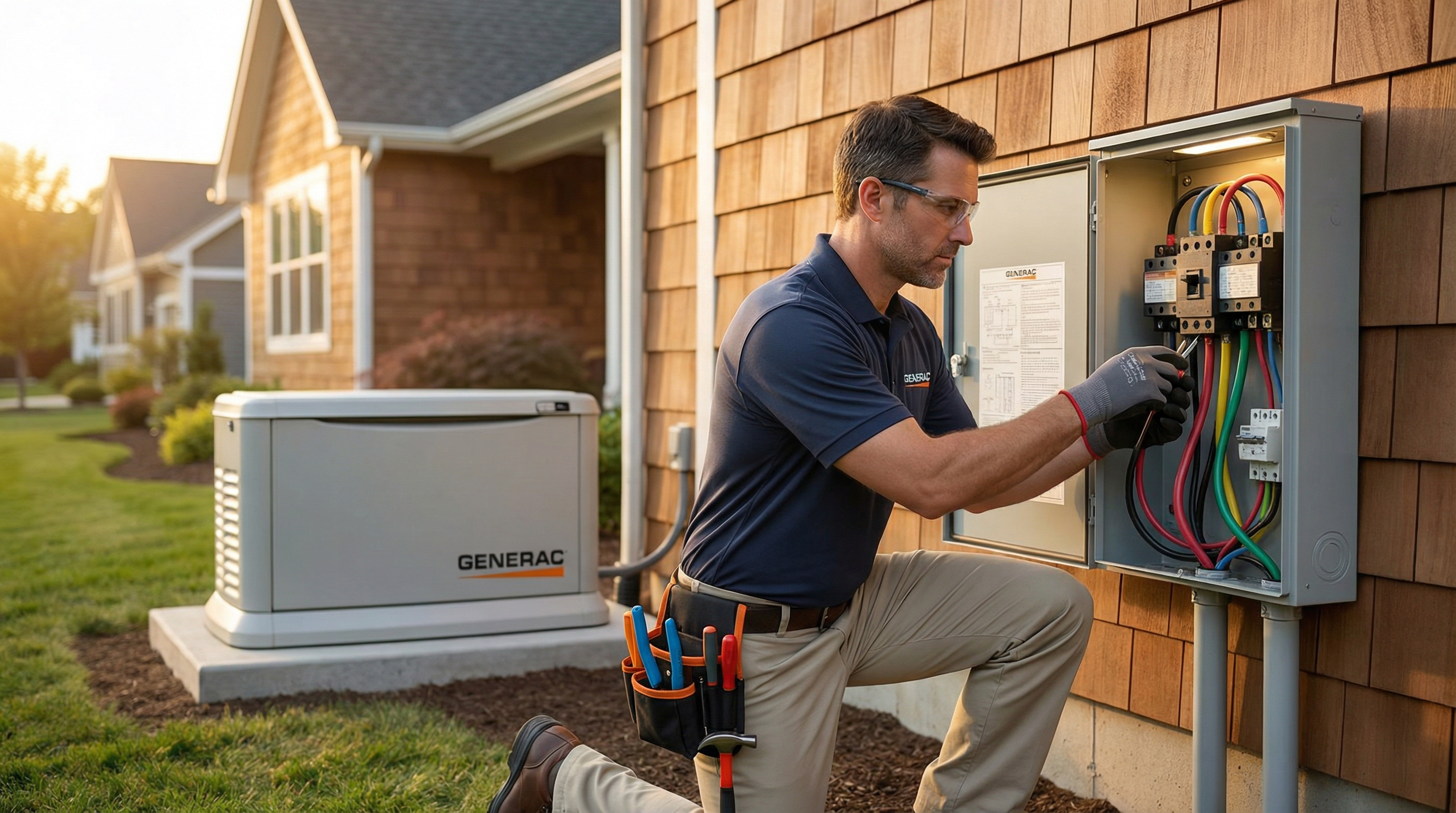
A residential standby generator installation has five core components, each representing both a cost center and a profit opportunity:
1. The Generator UnitHome standby generators range from 10kW to 26kW for residential applications. According to Generac's installation guide, equipment costs run $2,000-$6,500 depending on capacity. Natural gas and propane models dominate the residential market due to stable fuel supply and automatic operation.
2. Automatic Transfer Switch (ATS)The ATS monitors utility power and transfers load to the generator within seconds of an outage. Per NEC Article 702.4, transfer equipment must prevent inadvertent interconnection of normal and standby sources—this is a non-negotiable safety requirement. ATS units cost $600-$1,200 depending on amperage rating.
3. Concrete Pad and Site PreparationGenerators require a stable, level surface with proper drainage. Site prep runs $500-$1,000 including a 3-4 inch concrete pad and gravel base.
4. Fuel ConnectionNatural gas line installation costs $12-$25 per linear foot. Propane installations require tank placement ($500-$2,500 for 250-500 gallon tanks) plus line runs.
5. Electrical IntegrationThis is where your expertise commands premium pricing. Transfer switch installation averages 4 hours of labor ($1,200+ at standard rates), plus load calculations, panel modifications, and final testing.
How Do You Size a Residential Generator Correctly?
Undersizing means angry callbacks; oversizing wastes the customer's money. According to Electrician U's sizing guide, proper sizing requires calculating both running watts and starting (surge) watts for all critical loads.
The Basic Formula:
- List all appliances the customer wants to power during an outage
- Sum the running wattage of each item
- Identify the largest motor load (HVAC, well pump, sump pump)
- Add 25% reserve capacity for future expansion
Critical Loads to Include:
- Central AC: 3,800-5,000 running watts, 7,200-12,000 starting watts
- Electric furnace: 5,000-25,000 watts depending on size
- Well pump: 1,000-2,000 running, 2,000-4,000 starting
- Refrigerator: 150-400 running, 1,200-2,000 starting
- Sump pump: 800-1,500 running, 1,300-2,900 starting
Pro tip: Use the customer's utility bill to verify calculations. NEC 220.87 allows you to use demand meter readings from the previous 12 months as an alternative sizing method—this catches loads the customer might forget to mention.
For most 2,500 square foot homes with central AC, a 20-24kW generator handles the full load. Homes with electric heating, multiple AC units, or well pumps may need 26kW or larger.
What Are the NEC Code Requirements for Residential Generators?
NEC Article 702 governs optional standby systems—the category covering most residential generator installations. Understanding these requirements separates professional installs from code violations waiting to happen.
Transfer Switch Requirements (702.5)All generators must use listed transfer equipment to prevent backfeed to utility lines. According to EC&M's NEC code analysis, backfeed creates significant safety hazards for utility workers and can damage both grid infrastructure and customer equipment.
Manual transfer switches are permitted under Article 702, but automatic transfer switches (ATS) are standard for permanent installations. The ATS must be sized to handle the full service entrance capacity or the generator's maximum output, whichever is less.
Signage Requirements (702.7)A placard must be placed at the service entrance indicating the presence and location of the standby power source. This is critical for first responders and utility crews who may need to de-energize the building during emergencies.
Grounding (702.11)The generator's grounding must comply with Article 250. For separately derived systems, a grounding electrode conductor connects the generator to the grounding electrode system. For non-separately derived systems (most residential ATS installations), the neutral-ground bond exists only at the main panel.
Clearances and SetbacksGenerator exhaust must be at least 10 feet from any building openings per mechanical code requirements. Check local ordinances for additional setback requirements from property lines—some municipalities require 5-10 feet minimum.
How Should You Price Generator Installations for Profit?
The total installed cost for a residential standby generator ranges from $8,000 to $16,000 according to Generac's dealer network. Your pricing should capture the full complexity of the work while remaining competitive.
Cost Breakdown for a Typical 20kW Installation:
ComponentCost RangeGenerator unit (20kW)$4,500-$5,500Automatic transfer switch$800-$1,200Concrete pad/site prep$500-$1,000Gas line connection$300-$800Permits and inspections$200-$500Labor (electrical)$1,500-$3,000Labor (plumbing/gas)$400-$800Total$8,200-$12,800
Margin Optimization Strategies:
1. Bundle the Complete PackagePosition yourself as the single point of contact. Coordinate concrete, plumbing, and electrical work under one contract. Mark up subcontractor costs 15-20% for project management.
2. Offer Maintenance ContractsGenerator maintenance runs $200-$650 annually for oil changes, filter replacement, and system testing. According to Angi's maintenance cost guide, this recurring revenue stream also positions you for warranty repairs and future upgrades.
3. Upsell Smart MonitoringWi-Fi enabled generators with remote diagnostics command $300-$500 premiums. Customers love smartphone alerts, and you can offer remote troubleshooting as a value-add service.
4. Create Good-Better-Best Options
- Good: Essential circuits only (partial-home coverage), manual transfer switch
- Better: Whole-home coverage, automatic transfer switch, standard monitoring
- Best: Whole-home with smart monitoring, extended warranty, annual maintenance included
The "Better" option should be your target—it represents the sweet spot of capability and margin.
How Trade Agent Helps You Win More Generator Jobs
Quoting generator installations involves multiple variables: equipment costs, labor hours, subcontractor coordination, permit fees, and material markups. Miss one element and your margin evaporates.
Trade Agent's AI-powered estimating creates professional generator quotes in minutes. Upload the site photos and specs, and Arti calculates load requirements, generates itemized proposals, and builds change orders when scope shifts. The average contractor saves 11+ hours weekly on admin work—time you could spend closing more generator leads.
For generator work specifically, Trade Agent helps you:
- Build accurate load calculations based on customer appliance lists
- Generate professional proposals that demonstrate technical expertise
- Track project phases across electrical, plumbing, and site prep
- Schedule inspections and coordinate subcontractor availability
- Invoice milestone payments as work progresses
When a homeowner is choosing between three electricians, the one with the professional, itemized quote wins the job.
Conclusion
Standby generator installations combine technical complexity, code compliance, and multi-trade coordination—exactly the kind of work that commands premium pricing. With grid reliability declining and homeowner awareness rising, demand will only grow. The electricians who master sizing, code requirements, and profitable pricing will capture the largest share of this expanding market.
Ready to add generator installations to your service mix? Start by getting certified through your local Generac, Kohler, or Briggs & Stratton dealer network. Then build your quoting process with Trade Agent to ensure every proposal captures the full value of your expertise.
Get your free Trae Agent Demo →
Frequently Asked Questions
How much does a whole-home generator installation cost?
Total installed costs range from $8,000 to $16,000 for a 20kW residential system, including equipment, transfer switch, site preparation, fuel connection, and labor.
What size generator do I need for a 2,500 square foot home?
Most 2,500 square foot homes with central AC require a 20-24kW generator. Homes with electric heating or multiple AC units may need 26kW or larger.
Do I need a permit to install a standby generator?
Yes. Most jurisdictions require electrical, plumbing, and mechanical permits. Expect permit and inspection costs of $200-$500 total.
What is NEC Article 702?
NEC Article 702 covers optional standby systems—residential generators that provide backup power for convenience rather than life safety. It specifies transfer switch requirements, signage, and grounding standards.
How long does a generator installation take?
A complete installation typically takes 1-2 days of on-site work, but the full process—including permits, equipment delivery, and inspections—spans 2-4 weeks.
What's the difference between manual and automatic transfer switches?
Manual transfer switches require homeowners to physically switch power sources during an outage. Automatic transfer switches (ATS) detect outages and transfer load within seconds without intervention.
How far must a generator be from the house?
Generator exhaust must be at least 10 feet from building openings. Check local codes for additional setback requirements from property lines and neighboring structures.
What maintenance does a standby generator require?
Generators need oil changes, filter replacement, and system testing annually. Maintenance costs run $200-$650 per year, and neglecting it can void warranties.
Updated January 2026


Similar posts

Book Your Demo


