
General Contracting
AI Estimation for Contractors: What Actually Works in 2026
According to a survey of 600+ contractors, 78% are already using or testing AI tools. But if you dig into the numbers a little deeper you get a different picture: 45% have zero AI implementation. Less than 1% have AI fully embedded in their workflows. That gap between "playing with ChatGPT" and "this thing actually runs my estimates" is where most contractors are stuck right now.
I've talked to enough GCs and subs over the past year to know the pattern. Somebody at a conference shows you a demo. It looks incredible. You download something, poke at it for a week, and then it sits in a folder next to that project management tool you were going to switch to last January. The AI estimation landscape in 2026 is crowded, confusing, and most of it was built for a contractor that doesn't look like you.
So let's sort through what actually works. Not the pitch deck version, the version where you're a residential sub doing 80 jobs a year out of a truck, or a GC coordinating 15 trades on a custom build and your "estimation process" is a text thread and a prayer.
Most AI Estimation Tools Assume You Have Blueprints
The majority of AI estimating software on the market right now falls into one bucket: automated plan takeoff. You upload a blueprint or a set of architectural drawings, and the software identifies doors, windows, linear footage, square footage. It counts things. It measures things. It pulls from a material database and generates quantities.
This is real technology and it works. Tools like ProEst report accuracy rates in the high 90s on quantity takeoffs. An ASCE survey from December 2025 found that among the 27% of firms actually using AI in operations, 94% plan to increase usage this year. When it fits, it fits well.
The problem is who it fits.
Plan takeoff AI was designed for commercial estimators who sit at a desk, receive a set of plans from an architect, and build a detailed cost model before bidding. That workflow describes maybe 30% of the residential construction market. If you're a plumber who gets a text from a GC that says "got a 3/2 remodel in Thornton, can you bid the rough-in by Thursday," you're not working from a set of stamped MEP drawings. You're working from a walkthrough, a few photos on your phone, and whatever the GC's project manager remembered to mention.
David Wilson, Manager of Functions at Bechtel, insists that AI is "changing days of activity into minutes." That's true at Bechtel's scale, where they have a historic library of project data to train on. For the sub with 8 employees and a QuickBooks account, the starting conditions are different.
What a $5M Sub Actually Needs From an Estimating Tool
92% of construction firms report difficulty finding qualified workers. When you can't find enough people to do the work, you definitely can't find someone to sit in an office and build estimates all day. For most residential subs, the owner is the estimator. The owner is also the project manager, the closer, and the person who shows up when somebody calls in sick on a Tuesday.
Trade Agent's own customer research puts it at 2-4 hours per manual estimate for subs in the $5M-$50M range. Five estimates a month — which is light for a growing operation — eats 10-20 hours. That's half a work week spent on bids you might not win. The industry average win rate on competitive bids runs 10-25%, which means most of those hours produce nothing.
So what does an AI estimating tool look like for this person?
It doesn't start with a blueprint upload screen. It starts with a photo of the jobsite, a voice note describing the scope, or a forwarded text from a GC with a punch list. The estimate needs to account for local material pricing and labor rates without requiring a 200-line cost database setup. And it needs to produce something a GC can actually read and compare against other bids, not a proprietary format that requires the GC to also be on the platform.
This is the gap in the market that most AI estimation content doesn't talk about. Every top-ranking article for "AI construction estimating" assumes the user has plans. Keymakr talks about BIM integration and ML algorithms. The Mastt roundup reviews tools built for developers and enterprise consultants. Meanwhile, 150,000+ residential sub firms in the U.S. are still estimating on spreadsheets or legal pads because nobody built the tool that matches how they actually work.
A quick aside on accuracy claims. You'll see "97% accuracy" and "98% accuracy" thrown around in every vendor's marketing. Those numbers measure quantity takeoff accuracy against plan sets — how well the software counts windows and measures walls. They don't measure whether your total project estimate matches what the job actually costs. Oxford research found that 85% of construction projects experience cost overrun, with an average overrun of 28%. Accurate takeoffs are necessary but not sufficient. The estimate is only as good as the scope it's based on, and scope on residential work shifts by the week.
The Estimation Handoff That Kills Margins
Nobody in the AI estimation conversation is talking about what happens between the GC and the sub.
A GC sends a bid request to five subs. Those five bids come back in five different formats: one as a PDF, one as an email with line items pasted in the body, one as a text message with a lump sum, one as a phone call (that the PM forgot to write down), and one as a proper estimate from the sub who actually uses software. The GC's estimator or PM then manually transcribes those into a spreadsheet to compare. So it's no surprise that incomplete or misaligned trade quotations are a primary source of hidden risk in the base estimate.
This is where margin erosion starts and it has nothing to do with AI accuracy rates. It has to do with a plumber texting "$14,500 rough-in" and the PM entering it as $14,500 for rough and finish because the scope wasn't clarified. Or a GC comparing five bids without realizing that two of them excluded permits and one included material markup while the others didn't.
An AI tool that makes the sub's estimate faster doesn't fix this if the GC still receives a jumbled text message. The fix requires both sides of the transaction to be speaking the same language — or at least have a system that translates between them. This is less of a technology problem and more of a coordination problem that technology could solve if anyone bothered to build for it.
Jeff Sample, Senior Industry Development Manager at Bluebeam, put it well: "AI can't tell you anything without data that it cannot find, so start with data." The data problem in residential estimation isn't that we lack historical cost databases. It's that the data flowing between GC and sub is unstructured, inconsistent, and usually trapped in a text thread.
What "Actually Using AI" Looks Like vs. Downloading an App
Usman Shuja, CEO of Bluebeam, says that "the biggest barriers to AEC technology adoption in 2026 aren't cost — they're complexity, culture, and connection." Based on the data, he's right.
The ASCE/Bluebeam survey found that 52% of professionals still use paper during the design phase and 49% during planning. Meanwhile, 44% of firms told the AGC they're increasing AI investment this year. You can hold both facts in your head at the same time: the industry wants AI and the industry is still printing out drawings.
Look, clearly AI estimation in 2026 works well for a narrow set of use cases and falls apart outside of them. Plan takeoff from clean architectural drawings? Genuinely good. Automated quantity counting? Reliable. Material cost lookups against regional databases? Solid.
But residential estimation from ambiguous scope? Photo-based pricing for remodel work where half the scope is hidden behind drywall? Converting a GC's verbal description into a structured bid? That's where the technology is still catching up, and where the contractors who figure it out first will have a real advantage.
McKinsey's pegs the industry's productivity growth at roughly 1% annually over 20 years, compared to 3.0% for manufacturing. A $1.6 trillion global opportunity exists if construction catches up. But that opportunity won't be captured by tools that only serve the 30% of the market that already has clean data and formal processes.
Where Trade Agent Fits In This Landscape
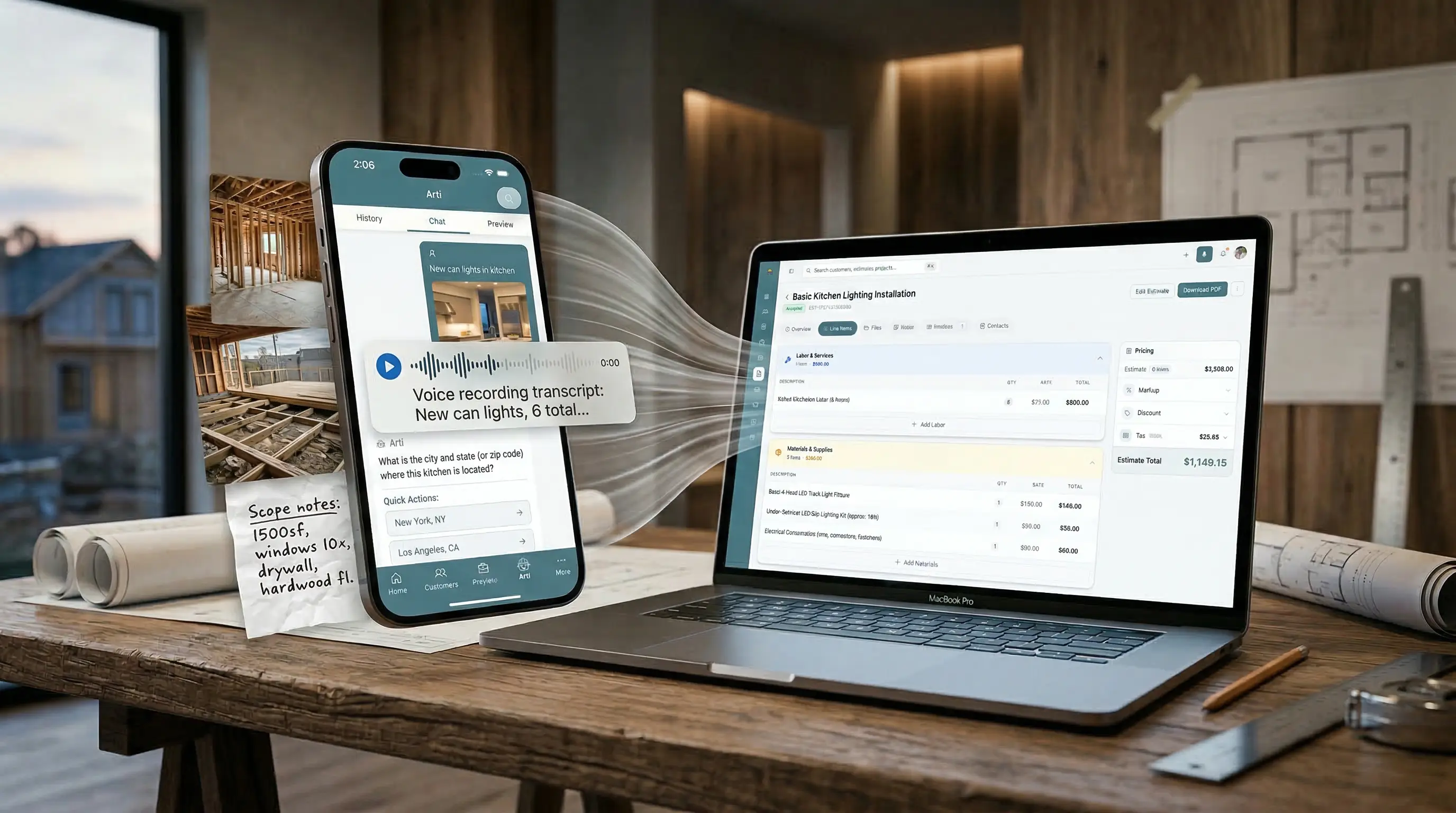
Trade Agent approaches AI estimation differently than the plan-takeoff tools because it was built for a different starting point. Instead of requiring architectural drawings, Art— Trade Agent's AI assistant — generates estimates from photos, voice descriptions, and text-based scope inputs. A sub can walk a jobsite, dictate what they see, and get back a structured estimate with line items, labor, and materials priced against local market data.
But the more significant piece is what happens after the estimate exists. That estimate lives inside the same system that handles invoicing, draw packages, and GC-sub communication through Trade Agent's subcontractor portal. When a GC sends a bid request through the platform, the sub's estimate comes back in a format the GC can directly compare, approve, and track through the project lifecycle. The estimation data flows into invoices. The invoices flow into draws. Nothing gets re-keyed. Nothing gets lost in a text thread.
For GCs at the Tier 2 level ($5M-$50M in volume), Trade Agent replaces the bookkeeper at a fraction of the cost — processing invoices, protecting budgets, and building bank-ready draw packages. For subs, Arti compresses 2-4 hours of estimation into minutes. Both sides connect on one platform, which means the estimation handoff problem described above starts to disappear.
The Test That Matters
Forget the accuracy percentages and the vendor benchmarks for a minute. The test for whether AI estimation works for your business is simpler than that.
Can you go from "got a bid request" to "estimate sent" in under an hour instead of half a day? Does the estimate flow into your invoicing without re-entry? Can the GC actually compare your bid against others without calling you to ask what you included?
If the answer to all three is yes, you're in the less-than-1% that RICS says have AI fully embedded. If the answer is no, you're in the 78% that ABC says is "using or testing" — which mostly means you've downloaded something and haven't gotten around to it yet. With Harvard JCHS projecting $524 billion in homeowner renovation spending this year, the contractors who close that gap between testing and using will be the ones capturing the work.
Matt Abeles, VP of Construction Technology at ABC, summed up the demand: "Contractor members want more information on AI and how it can help them improve safety, quality and profitability — and win more work." The information is out there. The question is whether the tools are built for how you actually work.
---
Frequently Asked Questions
Does AI estimation work for residential contractors?
It depends on the tool. Plan takeoff software works if you have architectural drawings. For residential subs working from walkthroughs, photos, and GC text messages, you need a tool that accepts those inputs — most don't. Trade Agent's Arti was built for exactly this workflow.
How accurate is AI construction estimating?
Quantity takeoff accuracy hits 97-98% against plan sets, according to benchmarks from ConstructionBids.ai. Total project cost accuracy depends on scope quality, not just software. 85% of projects still experience cost overruns averaging 28%.
What's the difference between AI takeoff and AI estimation?
Takeoff counts and measures from plans — square footage, linear feet, fixture counts. Estimation adds pricing, labor rates, overhead, and profit to those quantities. Most "AI estimation" tools are really AI takeoff tools that plug into a cost database.
How much does AI estimating software cost?
Ranges from free trials to $25,000+ for enterprise implementations. Point solutions like Handoff run about $1,788/year. Full-platform solutions with estimation plus invoicing and project management range from $399/year for subs to $10,000/year for GCs.
Can AI replace my estimator?
Not yet, and probably not soon. AI handles the repetitive parts — counting, measuring, pricing lookups, formatting — and lets your estimator focus on scope judgment, risk assessment, and client relationships. The ASCE/Bluebeam survey frames the best use case as AI as "assistant," not replacement.
What percentage of contractors actually use AI for estimating?
ABC says 78% are "using or testing" AI broadly. RICS found less than 1% have AI fully embedded in workflows. The real number for estimation specifically is somewhere in between...a lot of experimentation, very little full adoption.
Is photo-based estimation accurate enough for bidding?
For residential scope where formal plans don't exist, photo-based estimation with AI provides a structured starting point that's more consistent than a mental estimate jotted on a notepad. Accuracy improves with supplemental input (voice notes describing hidden conditions, measurements, GC scope details).
How long does it take to set up AI estimating software?
Simple tools with preset cost databases: under a day. Enterprise plan takeoff platforms with custom integrations: 1-3 months. The fastest path is choosing a tool that works with your existing workflow rather than requiring you to restructure around it. You can start using Trade Agent in minutes.



Similar posts





Book Your Demo


